

Table of Contents
My Fraudblocker.com Review: Your Ultimate Guide to Crushing Click Fraud and Supercharging Ad Spend
Online advertisers are bleeding an estimated $35 billion annually to click fraud, a massive drain on budgets that completely messes with your campaign data. In this deep dive into Fraudblocker.com, I’ll uncover how real-time ad fraud protection can claw back that wasted spend, seriously boost your ROI, and lock down the integrity of your campaign data.
I’ll break down exactly what Fraud Blocker does, explore its great features and pricing, weigh the good against the not-so-good, see how it stacks up against the competition, walk you through the setup, share what actual users are saying, and tackle those burning questions. By the time you’re done here, you’ll get why Fraud Blocker is a game-changer for small businesses and marketers laser-focused on getting the most bang for their digital advertising buck.
In this fraudblocker.com review, I’ll uncover how real-time ad fraud protection can claw back that wasted spend. As a multiple business owner myself, I know how important fraud protection is for your business. It’s easy to say “Oh, it won’t happen to me.” but the reality is that fraud happens to small business owners every single day. I hear about and read about it online all the time. The best protection you can take as a small business owner is the take proactive action. It’s better than having to deal with the fall out of click fraud after it has happened.
So, What is Click Fraud, Exactly?
Click fraud is when people or applications click on online ads with no real intention of buying or using the product. The purpose can be to waste a competitor’s advertising budget, to steal ad revenue from a publisher, or to manipulate ad network metrics. Think, if a competitor of yours clicks on your ads until it has reached its daily budget, they have spent your money and now their ads will show instead of yours.
How attackers use automation and bots (explained simply)
- Automated scripts – Attackers write small programmes that repeatedly open a web page and click an ad. These run much faster and at much higher scale than a human could.
- Botnets – A botnet is a group of infected computers or devices controlled remotely. The attacker orders those devices to visit pages and click ads, making the traffic look like many different users.
- Headless browsers – These are browsers that run without a visible window. They behave like a real browser but can be controlled by scripts to load pages and click ads automatically.
- Click farms – Instead of software, some attackers pay people to click ads manually. These people often work in shifts and use different phones or browsers to make the clicks look legitimate.
- IP rotation and proxies – To hide the source of clicks, attackers route traffic through many different IP addresses or proxy services. That makes the clicks look like they come from many different locations.
- Fake user behaviour – Bots try to mimic real users by moving the mouse, scrolling, or waiting before clicking. Some use delayed clicks or random intervals to avoid detection.
- CAPTCHA and anti-bot evasion – Advanced tools can solve or bypass simple CAPTCHAs, or they use human solvers to pass checks that would otherwise block automated activity.
Why this matters for a business
- Wasted budget – You pay for clicks that do not lead to genuine interest or sales.
- Skewed data – Fraudulent clicks distort campaign analytics, so you cannot tell which ads or keywords are actually working.
- Higher bid costs – If your ads appear less effective, ad platforms may require higher bids to win placements.
- Poor decision making – Marketing choices based on bad data can lead to wasted time and wrong optimisations.
How to spot click fraud (practical signs)
- Sudden spike in clicks without matching conversions.
- Very short site visits with immediate clicks away.
- Many clicks from the same IP address, or lots of clicks from unusual geographic locations.
- Strange patterns in timing, for example many clicks at exact intervals.
- High click-through-rate combined with low conversion rate.
Basic steps to protect and reduce impact
- Enable conversion tracking so you can measure clicks that lead to real actions.
- Monitor analytics for sudden changes in clicks, conversion rate, session duration, or unusual geography.
- Block suspicious IP addresses and ranges where you see repeated bad behaviour.
- Use ad network protections. Major ad platforms offer click-fraud detection and refund policies, and often provide reporting tools.
- Apply rate limits and bot detection on landing pages, for example challenge suspicious visitors with additional checks.
- Work with specialist click fraud services if the problem is large or persistent. They use advanced detection methods and can automate mitigation.
- Use CAPTCHAs or simple interaction checks on critical forms to make automated conversion-farming harder.
- Invest in products such as fraudblocker.com
Benefits of detecting and preventing click fraud
- Better return on ad spend, because your budget goes toward genuine prospects.
- Cleaner, more reliable campaign data, enabling smarter optimisation.
- Lower wasted ad spend and fewer surprises in billing.
- Stronger confidence in campaign performance, so you can scale what actually works.
What Exactly is Fraud Blocker and How Does It Shut Down Click Fraud?
In my fraudblocker.com review, I will explain how this software safeguards your ad budgets.
Fraud Blocker is a slick web-based software that spots and stops bogus ad clicks in their tracks, analysing traffic patterns at the pixel level to safeguard your ad budgets and supercharge campaign performance. It’s a combo of a lightweight tracking pixel and some seriously smart analytics that can tell the difference between real humans and those pesky bots, competitors, or click farms. For instance, if a bot script tries to hammer your ads with repeated clicks, Fraud Blocker’s rule engine instantly flags and blocks that IP address, saving your ad spend for actual potential customers and making your budget work way harder.
Think of it like this… You run an ad for your small online business but instead of that stream of new customers that you should be getting, your ad spend is being used up by bots who’s only goal is cause havoc and rinse your ad spend.
This fraudblocker.com review highlights the importance of stopping invalid traffic and ultimately, protecting your small business.
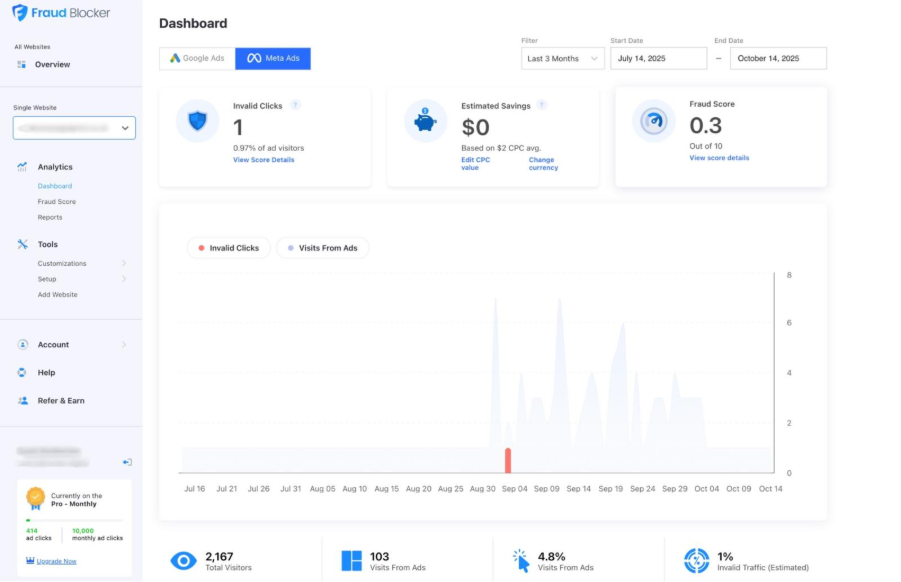
What’s the deal with click fraud and why is it trashing your online ads?
Click fraud is when automated bots, click farms, or sneaky scripts repeatedly click on your pay-per-click ads without any intention of buying, totally skewing your campaign metrics and burning through your budget. By artificially inflating your click counts, click fraud means you’re wasting ad money, seeing fewer actual conversions, and getting garbage data in your Google Ads or Meta Ads dashboards. Getting a handle on this is crucial because stopping invalid traffic means your ad dollars are actually connecting with real customers and giving you accurate ROI figures.
Can you imagine finding the budget to start your ad campaign to then have it hijacked by click fraud? Not only is it wasted budget but it’s also wasted time and will probably stop you putting out ads, which means no new customers – the whole reason you started ads!
Through this fraudblocker.com review, I will explore how the tracking pixel works.
How does Fraud Blocker catch and block fraudulent clicks in real-time?
As noted in this fraudblocker.com review, the software defends against various kinds of ad fraud.
I will hopefully help to improve your understanding through this fraudblocker.com review of the software’s features.
Fraud Blocker nabs fraudulent clicks by dropping a tracking pixel onto your landing pages, then scrutinising user behavior and network signals against its pre-set rules, triggering an immediate block. Its detection smarts include device fingerprinting, checking IP reputations, and scoring anomalies that flag sketchy patterns like super-fast, repeated clicks. Once flagged, the system automatically updates its firewall rules to shut down any further interactions from those bad actors, keeping your campaigns protected without you lifting a finger.
As explored in this fraudblocker.com review, real-time monitoring is crucial for effective fraud detection.
What kinds of ad fraud does Fraud Blocker defend against?
Fraud Blocker throws up a multi-layered defense against all sorts of ad fraud – think bots, click farms, pixel stuffing, and ad stacking, using smart detection strategies and custom blocking rules. It’s brilliant at spotting issues like location spoofing, redirect attacks, and incentivised clicks by matching click behavior with network fingerprints. The end result? You get clean traffic, and your campaign data stays rock-solid, giving you way more reliable performance insights.
You also have the security of knowing that you’re not putting yourself at risk of click fraud or wondering if your results are being skewed. Ultimately, this will help you build campaigns and tweak them as necessary, without worrying whether the results you’re working with are actually the result of unsavoury online behaviour.
What Are the Killer Features and Perks of Fraud Blocker Software?
Fraud Blocker packs a punch with real-time monitoring, AI-powered analysis, and flexible blocking controls designed to slash your ad spend waste, crank up your conversion rates, and fuel data-driven optimization. Every single feature is crafted to tackle a specific aspect of click fraud, ensuring it’s a breeze to integrate and provides non-stop protection for your Google Ads and Meta Ads campaigns.
How does real-time monitoring and automated IP blocking actually work?
Real-time monitoring pipes click events straight into Fraud Blocker’s analytics engine. This engine then applies its fraud rules to every single request and slaps dynamic IP blocks on any traffic that gets flagged.
It may be a bit hard to get your head around but let me break it down for you how the technology works:
- It dives deep into click velocity and weird behavioural patterns.
- It automatically updates its blocklists to banish repeat offenders for good.
- It slams the brakes on further resource drain by cutting off communication with malicious IPs instantly.
This constant flow means fraudulent sources get neutralised in mere seconds, saving your budget for genuine leads and keeping your performance data crystal clear.
What cutting-edge fraud detection tech does Fraud Blocker use?
Fraud Blocker pulls out all the stops, using a potent mix of machine learning, device fingerprinting, proxy and VPN detection, and heuristic analysis to sniff out suspicious traffic.
- Machine learning models are constantly learning and adapting to new fraud tactics.
- Device fingerprinting can tell unique browsers and devices apart.
- VPN and proxy detection unmasks those sneaky anonymized or masked connections.
- Heuristic rules meticulously evaluate click timing, frequency, and referrer data.
Together, these technologies seriously boost detection accuracy and make sure evolving threats are tackled head-on, keeping your ad campaigns locked down tight. This means that you can go about focusing on your campaigns rather than worrying on whether that ad spend is being stolen from you.
How much can you tweak Fraud Blocker’s fraud rules and geo-blocking?
Fraud Blocker actually offers a lot of customisation, which is really handy. Its fully customisable rule engine lets you dial in thresholds for click frequency, session duration, and even geo-based restrictions to perfectly match your campaign goals. So you can literally tweak it as much as you need to.
- You can set precise click-per-minute limits.
- You can automatically exclude entire countries or IP ranges.
- You can fine-tune sensitivity levels for different campaigns.
This level of flexibility puts you in the driver’s seat, allowing you to tailor protection to your exact traffic quality expectations, optimising both your reach and your safety.
How does Fraud Blocker play nice with Google Ads and Meta Ads platforms?
Getting Fraud Blocker hooked up with Google Ads and Meta Ads is a cinch. Literally, just pop in a tracking pixel or configure it through your tag manager. It syncs up click events with your campaign IDs for super smooth reporting. Super simple and super easy!
Once you’ve done that, then:
- Tracking pixels grab all the essential ad click metadata.
- Dashboard widgets show you blocked vs. accepted clicks right alongside your cost metrics.
- Data exports line up perfectly with your Google Analytics and Meta Business Suite reports.
This native integration makes oversight a breeze and sets you up for unified optimisation workflows. It’s probably a lot simpler than you thought, right?
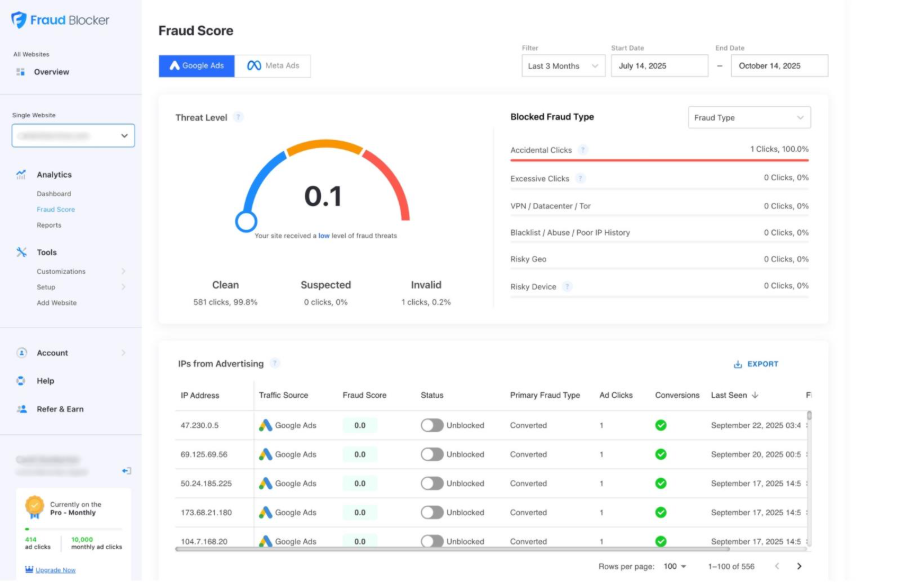
What reporting and fraud scoring features does Fraud Blocker dish out?
Here’s a breakdown of what Fraud Blocker offers in terms of reporting and scoring:
These insights are gold for pinpointing weak spots and tweaking your campaigns for sustained performance wins.
How Much Does Fraud Blocker Cost and What Are the Pricing Plans?
Fraud Blocker rolls out tiered pricing that’s designed to align with your ad spend and feature needs, ensuring your costs are predictable and your ROI is crystal clear.
What pricing tiers does Fraud Blocker offer and what’s included in each?
Here’s a quick look at the plans available:
Each plan scales your protection as your advertising budget grows, making it easy to invest more in fraud prevention as you scale.
How does Fraud Blocker’s ROI make the investment in ad fraud prevention totally worth it?
My fraudblocker.com review shows you that the tiered pricing that aligns with your needs.
Putting your money into Fraud Blocker typically saves you 10–20% on wasted ad spend by blocking those invalid clicks before they even cost you a penny.
- Your cost per acquisition drops thanks to cleaner traffic.
- Your conversion rate gets a boost as your budget shifts to genuine prospects.
- The payback period on your ad spend shrinks because you’re not letting your budget get drained.
These wins translate directly into a measurable jump in your campaign ROI, quickly covering the cost of your subscription. The real question is, can you afford not to use Fraud Blocker if you’re running ads?
What Are the Upsides and Downsides of Using Fraud Blocker?
As always, I’m not just going to show you the good but the not so great points too. This ensures that I’m giving you the fairest review that I can. A look at the facts shows that Fraud Blocker offers solid defense against click fraud, but there are a few things to consider before you jump in. So before you decide to sign up, read through my key points to ensure it aligns for you.
What are the main wins for small businesses and marketers using Fraud Blocker?
- It makes your budget way more efficient by blocking invalid traffic instantly.
- It cleans up your campaign analytics with slick, integrated dashboards.
- It plays nicely with major ad platforms without any complicated setup.
- It automatically scales your protection as your ad spend ramps up.
These strengths give growing advertisers immediate confidence and tangible cost savings.
What limitations or headaches have users run into?
- Getting the hang of the advanced rule configuration can be a bit of a learning curve.
- Occasionally, legitimate clicks might get flagged, requiring some manual whitelisting.
- Geo-blocking might accidentally block real international prospects for a short time.
Tuning the sensitivity settings and keeping your whitelist updated usually sorts out most of these hiccups while still keeping your defenses strong.
At the end of the day, any software is going to have a certain level of limitation. But ultimately, if the pros outweigh the cons, it’s worth it. And in my opinion when it comes to running ad campaigns and how much they can cost if things go wrong, Fraud Blocker is worth its weight in gold.
How good is Fraud Blocker’s customer support?
Fraud Blocker offers 24/7 email support, live chat for Professional plan users and above, and dedicated account managers for enterprise clients, ensuring any issues get sorted out fast. They typically respond in under two hours, which is key for keeping your campaign protection running smoothly and building trust in your ongoing operations.
They’re pretty good and responsive overall if you need some help. 24/7 support is important and live chat is easy to use.
How Does Fraud Blocker Measure Up Against Top Competitors?
Putting Fraud Blocker head-to-head with its main rivals helps clarify which tool is the best fit for different businesses and highlights its unique advantages.
What are the key differences between Fraud Blocker and ClickCease?
How does Fraud Blocker compare to TrafficGuard and Lunio?
TrafficGuard and Lunio are solid enterprise-grade solutions, but Fraud Blocker really shines for small to mid-sized advertisers thanks to its super simple onboarding and clear, tiered pricing. While TrafficGuard focuses on financial institutions and Lunio zeroes in on fraud analytics consulting, Fraud Blocker prioritizes self-service flexibility and immediate ROI for digital marketing teams.
Which click fraud prevention software is the best fit for different types of businesses?
Matching the tool to the business ensures each organization picks the solution that best fits its scale and complexity.
How to Set Up and Use Fraud Blocker Like a Pro?
Getting Fraud Blocker set up and configured efficiently means you can start protecting your campaigns right away and ensure top-notch click fraud defense from day one. I value the ability to get started using something fast and so I appreciate their easy setup.
What are the step-by-step instructions for integrating Fraud Blocker with Google Ads?
- Log into your Fraud Blocker dashboard and grab your tracking pixel code.
- Paste that pixel into the <head> section of your landing page or add it via Google Tag Manager.
- Connect your Google Ads account within the Fraud Blocker integration settings.
- Use the Fraud Blocker Test tool to confirm that events are firing correctly.
- Flip the switch on real-time monitoring to start blocking those pesky invalid clicks.
Following these steps ensures a smooth flow of data between your ad campaigns and Fraud Blocker’s powerful analytics engine.
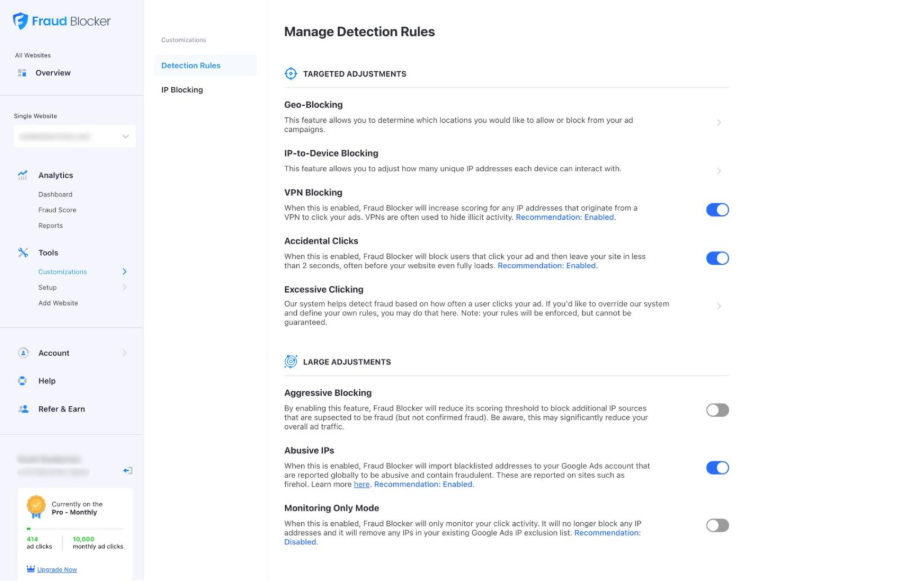
How do I configure custom fraud rules and geo-blocking in Fraud Blocker?
- Head over to the “Rules” section in your Fraud Blocker console.
- Create a new rule by picking your conditions (like a click rate threshold).
- Decide on the action (block, challenge, or just log) when those conditions are met.
- Jump into “Geo-filters” to either exclude or include specific regions.
- Save and apply your rules to your active campaigns for instant protection.
Custom rules and geo-blocking give you the power to fine-tune your protection to match the unique needs of your campaigns.
What are the best practices for nailing fraud detection and protecting your ad spend?
This fraudblocker.com review outlines the differences with ClickCease.
- Check your fraud score reports daily to tweak your rule sensitivity.
- Whitelist any key IPs to make sure you don’t accidentally block trusted partners.
- Combine geo-blocking with time-based rules to sync up with your peak traffic windows.
- Keep your rule sets updated regularly to stay ahead of new fraud patterns.
Putting these practices into play keeps your detection accuracy high and your ad budgets free from invalid traffic.
What Are Users Saying About Fraud Blocker?
Real-world feedback really shows how Fraud Blocker impacts ad performance, giving us a peek into its strengths and areas where it could get even better.
What are the common user experiences and success stories?
In this fraudblocker.com review, we provide step-by-step instructions for setting it up.
- One marketing agency saw a massive 25% drop in wasted clicks within just two weeks.
- An e-commerce store boosted its cost per acquisition by 15% after blocking proxy traffic.
- A startup managed to reinvest its saved ad budget into new campaigns, driving a 20% increase in leads.
These examples really hammer home how Fraud Blocker helps turn saved ad spend into real, tangible growth.
How do user ratings reflect Fraud Blocker’s effectiveness?
Across various review sites, Fraud Blocker scores an impressive 4.6 out of 5 for its click fraud protection, with users consistently praising its ease of use and the clarity of its reporting. This steady stream of positive feedback highlights the software’s trustworthiness and its practical value for optimizing campaigns.
What improvements are users suggesting for future updates?
- They’d love to see more automated integrations with other analytics tools.
- More options for customizing the dashboard would be great for unique reporting needs.
- Pre-built templates for common fraud rules would speed up the onboarding process.
Frequently Asked Questions About Fraudblocker.com and Click Fraud Prevention
This section tackles the most common questions about legitimacy, capabilities, and alternatives to help you make a smart decision.
Is Fraud Blocker a legitimate and reliable tool for online advertisers?
Absolutely. Fraud Blocker is a trusted solution used by agencies and brands worldwide. It’s backed by clear privacy policies, public case studies, and consistently high uptime. Its reliability comes from a robust infrastructure, encrypted data channels, and regular security audits that ensure your campaign protection never skips a beat.
Can Fraud Blocker detect every single type of click fraud?
While Fraud Blocker covers a huge range of fraud methods – including bots, click farms, and proxy misuse – you might need to fine-tune custom rules for brand-new threats like domain spoofing or incentive-based fraud. Keeping your rules updated and leveraging machine learning updates helps maintain comprehensive coverage.
Does Fraud Blocker integrate with platforms other than Google Ads?
You bet. Fraud Blocker integrates seamlessly with Meta Ads, Bing Ads, and various tag manager tools. Plus, it offers a RESTful API for custom platform connections. This flexibility means your entire advertising ecosystem can benefit from consistent fraud detection.
How quickly does Fraud Blocker react to fraudulent activity?
Fraud Blocker acts within seconds of spotting suspicious behavior, automatically updating blocklists and preventing further invalid clicks. This near-instantaneous response maximizes budget protection and keeps your campaign metrics squeaky clean.
What are the best alternatives if Fraud Blocker isn’t the right fit for me?
If you’re an enterprise needing dedicated SLAs and consulting, TrafficGuard offers comprehensive support. Agencies looking for deep analytics might prefer Lunio, while smaller teams could explore simpler options like ClickCease for straightforward IP blocking. Each alternative is tailored to specific scales and feature requirements.
Fraud Blocker offers a streamlined, data-driven way to prevent click fraud that boosts your campaign ROI, works seamlessly with major ad platforms, and scales right along with your advertising budget. Its winning combo of real-time analytics, a custom rule engine, and transparent pricing empowers marketers to reclaim wasted spend and focus on connecting with genuine customers. By adopting best practices and harnessing advanced detection technologies, Fraud Blocker stands out as a top choice for businesses serious about defending their ad spend. Reach out to the Fraud Blocker team to explore a free trial and start optimising your campaigns today. This fraudblocker.com review encapsulates why you should consider this tool.
Feedback in this fraudblocker.com review shows its impact on ad performance.
As highlighted in this fraudblocker.com review, user ratings reflect the tool’s effectiveness.
This fraudblocker.com review confirms its reliability as a trusted solution.
In comprehensive detail, this fraudblocker.com review discusses integration capabilities.
This fraudblocker.com review wraps up by summarising its key benefits.
Ultimately, this fraudblocker.com review showcases its efficiency in preventing click fraud.
